by admin | Jan 11, 2012 | Blog, Strategy
First of all, we should acknowledge that marketing in general, and branding strategy in particular, for any professional service organisation has its own unique challenges. The offering is intangible, so you can’t pick it up and compare it feature for feature with a competing offering. The service also relies on humans to deliver it each and every time; it is subject to a lot more variability in quality than a physical product. This means that the quality of a service offering is based mainly on perceptions and external artifacts such as expensive offices, tailored suits and a difficult to complete degrees. The business is also based heavily on personal relationships and the collective intellectual property/knowledge base that a firm can build.
“…branding, a word misunderstood and misused more than any other in business”
Acknowledging these challenges, however, does not change the fact that the major role of branding strategy is still fundamentally about articulating a clear point of difference, one that is valuable to a clearly defined audience. Now let’s examine branding, a word misunderstood and misused more than any other in business. The goal of branding is to become the name people think of immediately when they want what you sell. The purpose of a Brand is to differentiate between products and services and meet aspirational needs as well functional requirements. Brands are the source of a promise to the consumer.
Exhibit A.
The following is a quote from the 2nd of March 2007 Australian Financial Review article, titled “Skills before Thrills” and worse still made by a principal of a marketing firm that conducted research into the marketing of law firms in Australia:
“Over the last 5 years law firms invested significantly into building their brand….While buyers of legal services are more aware of the number of firms they can choose from, they don’t know what these firms stand for, what differentiates them.”
Do we need to shout it out loud? – BRANDING IS DIFFERENTIATION! Maybe the author shouldn’t have skipped Lecture 2, Marketing 101!!! Maybe what they meant to say was that these firms ‘misdirected a lot of their marketing investment’ or ‘have spent a lot of money making prospects aware of their brands’ which is not the same as ‘building their brand’, in fact in fairness, the author alludes to this by calling it “empty awareness”. Building a brand means that your prospects know the difference between you and your competitor so well that they can clearly articulate it!
Why is it not surprising that the so called ‘branding efforts’ by the aforementioned law firms yielded poor results? Could it be that the advertising agencies and marketing consultants involved also missed a few lectures in Marketing 101? Or is it that they do not have the professional fortitude to stand up to their clients and insist that all drab, boring, chest beating ‘corporate speak’ communication must go?
It seems that Australian commercial law firms have either confused branding with visual image which is only a very small sub-set of the branding discipline (but hell who can blame them, marketing fraternity from practitioners to journalists don’t seem to understand the difference!) or they are collectively too conservative (scared) to really take a stand that makes them different and superior.
Exhibit B.
An article from Lawyers’ Weekly May 2008 cites a number of “rebranding case studies”, one of which is:
“We were keen to come up with an understanding a meaning of the brand that related to everyone. It really came down to two things that were really important to the firm. One was the quality of the work that we do and the second was how we do that work and how we relate to the people we’re doing that work with,” he said. “So for us [the issues were] excellence in terms quality of work we’re doing and building real rapport with our clients, with each other, and with other professionals involved with our work.” Blake Dawson worked on the project with brand consultants, Principals, for the best part of 18 months and it was officially unveiled on November 5 year. The effort paid off, and the rebranding was recognized as one of top five of the year in the 2008 Rebrand 100 Winning Brands awards.”
Is this another case of “Emperor’s New Clothes”? We tried to find evidence of the 2 key messages – quality of work and rapport with clients – that supposedly make Blake Dawson unique, communicated on the company website but with no success. Furthermore, the firm’s Positioning Statement “Would you like to grow a little faster?” unfortunately in no way reflects these 2 key messages. But at least the firm has a Positioning Statement and maybe this will focus the efforts of the company to deliver on their promise and assist clients in growing their bottom line. Additionally, Blake Dawson – www.blakedawson.com is one of the few firms to have at least tried to establish some kind of differentiation by incorporating cartoons in the firm’s marketing communications; however this great idea seems not to have been given enough oxygen. There are only 2 pages of the company’s website graced with this simple, humanizing and differentiating concept – unfortunately allowing a great opportunity go untapped.
The trouble is, all the big commercial law firms seem to be working from the same play book and to have taken the road more traveled – and have ended up being both boring and unfocused in their message.
Little wonder market research suggests that clients don’t know what differentiates one firm from another. Now, at the risk of offending people who know how to sue us for defamation… go to the web sites of the major players and look for a clear positioning statement, or anything that is “benefit focused.” If a first year copywriting cadet from AdSchool submitted any of these web sites for an assignment, they would fail because its “all about me” copy doesn’t give any clear differentiation from the competition.
What’s more, they generally try to be all things to all people. They all say, in effect, “we have a bunch of smart people and lots of offices and know the law and care about excellence…” yawn.
by admin | Jan 11, 2012 | Blog
First of all, we should acknowledge that marketing in general, and branding in particular, for any professional service organisation has its own unique challenges. The offering is intangible, so you can’t pick it up and compare it feature for feature with a competing offering. The service also relies on humans to deliver it each and every time; it is subject to a lot more variability in quality than a physical product. This means that the quality of a service offering is based mainly on perceptions and external artifacts such as expensive offices, tailored suits and a difficult to complete degrees. The business is also based heavily on personal relationships and the collective intellectual property/knowledge base that a firm can build.
“…branding, a word misunderstood and misused more than any other in business”
Acknowledging these challenges, however, does not change the fact that the major role of branding is still fundamentally about articulating a clear point of difference, one that is valuable to a clearly defined audience. Now let’s examine branding, a word misunderstood and misused more than any other in business. The goal of branding is to become the name people think of immediately when they want what you sell. The purpose of a Brand is to differentiate between products and services and meet aspirational needs as well functional requirements. Brands are the source of a promise to the consumer.
Exhibit A.
The following is a quote from the 2nd of March 2007 Australian Financial Review article, titled “Skills before Thrills” and worse still made by a principal of a marketing firm that conducted research into the marketing of law firms in Australia:
“Over the last 5 years law firms invested significantly into building their brand….While buyers of legal services are more aware of the number of firms they can choose from, they don’t know what these firms stand for, what differentiates them.”
Do we need to shout it out loud? – BRANDING IS DIFFERENTIATION! Maybe the author shouldn’t have skipped Lecture 2, Marketing 101!!! Maybe what they meant to say was that these firms ‘misdirected a lot of their marketing investment’ or ‘have spent a lot of money making prospects aware of their brands’ which is not the same as ‘building their brand’, in fact in fairness, the author alludes to this by calling it “empty awareness”. Building a brand means that your prospects know the difference between you and your competitor so well that they can clearly articulate it!
Why is it not surprising that the so called ‘branding efforts’ by the aforementioned law firms yielded poor results? Could it be that the advertising agencies and marketing consultants involved also missed a few lectures in Marketing 101? Or is it that they do not have the professional fortitude to stand up to their clients and insist that all drab, boring, chest beating ‘corporate speak’ communication must go?
It seems that Australian commercial law firms have either confused branding with visual image which is only a very small sub-set of the branding discipline (but hell who can blame them, marketing fraternity from practitioners to journalists don’t seem to understand the difference!) or they are collectively too conservative (scared) to really take a stand that makes them different and superior.
Exhibit B.
An article from Lawyers’ Weekly May 2008 cites a number of “re-branding case studies”, one of which is:
“We were keen to come up with an understanding a meaning of the brand that related to everyone. It really came down to two things that were really important to the firm. One was the quality of the work that we do and the second was how we do that work and how we relate to the people we’re doing that work with,” he said. “So for us [the issues were] excellence in terms quality of work we’re doing and building real rapport with our clients, with each other, and with other professionals involved with our work.” Blake Dawson worked on the project with brand consultants, Principals, for the best part of 18 months and it was officially unveiled on November 5 year. The effort paid off, and the re-branding was recognized as one of top five of the year in the 2008 ReBrand 100 Winning Brands awards.”
Is this another case of “Emperor’s New Clothes”? We tried to find evidence of the 2 key messages – quality of work and rapport with clients – that supposedly make Blake Dawson unique, communicated on the company website but with no success. Furthermore, the firm’s Positioning Statement “Would you like to grow a little faster?” unfortunately in no way reflects these 2 key messages. But at least the firm has a Positioning Statement and maybe this will focus the efforts of the company to deliver on their promise and assist clients in growing their bottom line. Additionally, Blake Dawson – www.blakedawson.com is one of the few firms to have at least tried to establish some kind of differentiation by incorporating cartoons in the firm’s marketing communications; however this great idea seems not to have been given enough oxygen. There are only 2 pages of the company’s website graced with this simple, humanizing and differentiating concept – unfortunately allowing a great opportunity go untapped.
The trouble is, all the big commercial law firms seem to be working from the same play book and to have taken the road more traveled – and have ended up being both boring and unfocused in their message.
Little wonder market research suggests that clients don’t know what differentiates one firm from another. Now, at the risk of offending people who know how to sue us for defamation… go to the web sites of the major players and look for a clear positioning statement, or anything that is “benefit focused.” If a first year copywriting cadet from AdSchool submitted any of these web sites for an assignment, they would fail because its “all about me” copy doesn’t give any clear differentiation from the competition.
What’s more, they generally try to be all things to all people. They all say, in effect, “we have a bunch of smart people and lots of offices and know the law and care about excellence…” yawn.
by admin | Jan 8, 2012 | Blog, Strategy
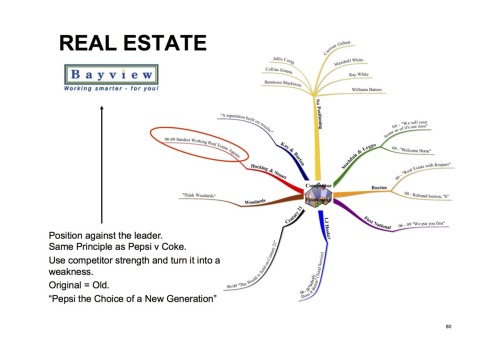
Here’s an example from the Real Estate category for one of our clients.
Using the ‘Pepsi strategy against Coke’, we have used the principal of taking a leading competitor’s strength “Hardest working Real Estate Agent” by Hocking Stuart and developing a brand positioning statement that capitalizes on their weakness:
- Everyone knows that it’s not about working harder but SMARTER
- We all have the perception of Real Estate agents being ‘sharks’ who only care about their bottom line and have hence made the Bayview positioning statement all about the buyer – YOU!
The result was “Working Smarter – For You”
It is interesting to note that Hocking Stuart, the very firm that became the marketing thought leader in their field has since changed their brand positioning twice since I first wrote this and now has no slogan or positioning statement at all! Do they now think that they are all grown up and don’t need one? I wonder how this will effect them…only time will tell and unless something drastic happens only they will know! What I am confident about is that they would have been much better off by sticking to and reinforcing their original slogan “Hardest Working Real Estate Agent”. Their size in the market (number of franchises / outlets) together with their marketing budget would have ensured their prominence and top of mind awareness in the minds of their customers and prospects.
For in depth exploration of the laws and principles of Brand Positioning in the marketplace, you can’t go past Al Ries – http://www.ries.com/.
by admin | Jan 8, 2012 | Blog
Here’s an example from the Real Estate category for one of our clients.
Using the ‘Pepsi strategy against Coke’, we have used the principal of taking a leading competitor’s strength “Hardest working Real Estate Agent” by Hocking Stuart and developing a positioning statement that capitalizes on their weakness:
- Everyone knows that it’s not about working harder but SMARTER
- We all have the perception of Real Estate agents being ‘sharks’ who only care about their bottom line and have hence made the Bayview positioning statement all about the buyer – YOU!
The result was “Working Smarter – For You”
It is interesting to note that Hocking Stuart, the very firm that became the marketing thought leader in their field has since changed their positioning twice since I first wrote this and now has no slogan or positioning statement at all! Do they now think that they are all grown up and don’t need one? I wonder how this will effect them…only time will tell and unless something drastic happens only they will know! What I am confident about is that they would have been much better off by sticking to and reinforcing their original slogan “Hardest Working Real Estate Agent”. Their size in the market (number of franchises / outlets) together with their marketing budget would have ensured their prominence and top of mind awareness in the minds of their customers and prospects.
For in depth exploration of the laws and principles of Positioning in the marketplace, you can’t go past Al Ries – http://www.ries.com/.
by admin | Oct 4, 2011 | Blog, Promotion, Strategy
According to a study by research company Millward Brown, slogan or brand positioning statement usage in advertising has been declining over the last 20 years.
The study found that slogans make a difference in advertisements, and generate more interest from the target audience. The Knowledge Point study, found that two-thirds of all ads actually included slogans.
Ads with slogans that part are of a jingle received higher enjoyment while slogans that have been used before also enjoyed better branding, confirming the importance of consistency and repetition.
The study provided the following advice to marketers and their brands:
- Positioning Statements that are most likely to be remembered are included in a jingle.
- Positioning Statements should be relevant and meaningful to the brand, its benefits or its history
- Positioning Statements used to make sense of the whole communication are memorable because they bring about a resolution to the “question” being asked
- Positioning Statements slogans that use rhyme or alliteration to associate with the brand are more easily remembered
- Positioning Statements that evoke memorable images or stimulate thinking have more staying power
- Distinct Positioning Statements, whether they contains an unusual word or are used in an unfamiliar context, were also found to be effective.

Recent Comments