by admin | Jan 20, 2012 | Blog, Promotion, Strategy
To develop an effective creative theme, your brand positioning needs to be different from what is prevalent in your industry segment. One way of doing this is staying away from standard photography stock photos. Not only will this not provide your business with the necessary point of difference but will play into the hands of the category leader, who is most likely already using the “typical” stock shots.
Here are some examples of effectively used creative themes:
A Gambling theme was used for a management consulting member organisation to communicate with both prospective members and encourage membership and potential clients, with the main messages being:
- don’t gamble with your career / business
- get the unfair advantage
A Cartoon theme for an accounting practice and a different cartoon theme for a management consulting firm both poking fun at their own practice were used to differentiate these companies from their competition that uses traditional and boring “corporate” photos of “smiling people in the office”
A visual Illusion theme for a marketing consultancy was used to deliver the message that things aren’t always what they seem and that Perception is Reality!
A theme of the world’s most famous Man-Made Landmarks was developed for a translation company to differentiate them and make their offer more memorable than their competitors.
A Car theme was designed for a web marketing company that was at the time an early developer of an easy to use web Content Management System:
- the brochure looked like a car brochure with all of the “driving analogies” being used to appeal to the mainly middle aged male business audience
- direct mail campaign using a “test drive” invitation, with keys and one pair of a glove, etc
- a user manual that resembled closely a car manual
- a license for clients completing the training course
A Medical theme was developed for an I.T. company. Most I.T. companies can’t get beyond the now “typical” I.T. Health Check. This I.T. company was able to develop a campaignable and timeless theme which was intrinsically linked to its Positioning Statement / slogan which was “taking care of I.T.”
- Mints in a medicine bottle could be used as promotional items for “pain relief”
- Different levels of I.T. Support were marketed like health insurance
- Invoices could be made to look like medical scripts
- Client files and proposals could be made to look like medical patient histories.
- Staff could dress up as doctors
Wild West theme was used by a design firm, with all the shoot outs, outlaws, sheriff and wanted posters to create a fun approach to selling this firm’s point of difference.
As you can see the creative theme for your business is only limited by your imagination. From police or detectives, to aliens and UFO’s, from tailoring to sailing, from army to mythology, the critical things to remember are:
- Making sure that your creative theme is clearly communicating and reinforcing either your brand name or your positioning statement
- That your creative theme is immediately comprehensible and doesn’t take too long for the prospective target audience to “get it”, otherwise you are just confusing them rather than helping them remember you and what makes you special
- Your creative theme is different to the themes being used in your industry segment
- Your creative theme provides you with a never ending well of ideas.
by admin | Jan 18, 2012 | Blog, Strategy
The creative strategy is the translation of the brand objectives and attributes, into communication that will:
Having a strong creative strategy is more important for the SME which doesn’t have the corporate budget to drum in the message using the sheer weight of media dollars. An SME is also in a better position to develop a strong creative strategy:
- Unlike a big corporate organisation, an SME does not have to deal with layers of management and political games.
- In most cases there is no brand baggage.
Creative strategy is rarely used by businesses outside the large and well established Consumer Goods and Services; from FMCG to Banking, Retail, Telecommunications, Cars, etc. B2B and Professional Services companies, and in fact most SME’s can benefit from having a Creative Strategy.
- Provides consistency which is crucial in building memorability and trust with the target audience
- Ideally, the theme is will be derived from or generate synergy with the brand name or the positioning statement.
- Allows for development of more ‘creative’ communication, which also makes it more memorable. Creative themes achieve this by developing synergy between words and graphics and thus become more memorable.This means that you do not have to expose your target audience to your message as many times as you would otherwise with ‘average’ or less interesting communication, which means you can spend less money communicating with your prospects to turn them into customers.
- Well communicated THEMES deliver greater marketing ROI because they go beyond features and benefits in the mind of the prospect and engage them emotionally as well as logically.
The more creative the communication, the more memorable and comprehensible it is. Which means that you do not have to expose your target audience to your message as many times as you would otherwise with ‘average communication’.
A consistent THEME that uses the name of the brand or its positioning or ultimately both will always yield better results in achieving the above objectives.
MORE CREATIVE = LESS FREQUENCY = GREATER ROI
by admin | Jan 13, 2012 | Blog, Design
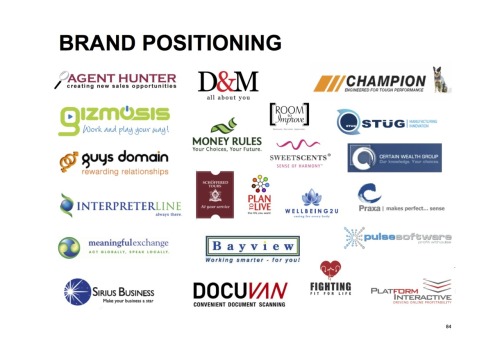
Brand Positioning
Here is a mix of examples of logos, brand names and positioning statements that we have had the pleasure of working with and/or developing for our clients.
Most importantly, note how easy it is to develop creative, campaignable marketing communication for these brands.
by admin | Jan 12, 2012 | Blog, Design

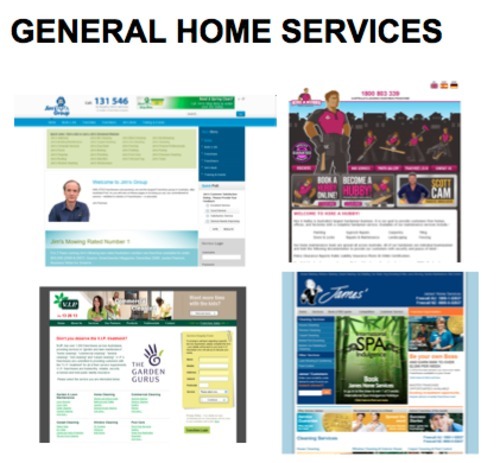
Take a look at the websites of 2 similar categories at different stages of maturity:
1. The General Home Services category and
2. A sub-segment of this category ‘Cleaning’
Their brand positioning are clearly shown through their design and content development.
The first is much more mature in terms of marketing communication. Its’ websites project a much more professional and corporate image.
The second is less professional and looks like it is a “small” business, which it is compared to the larger Head Office Marketing driven Franchise!
by admin | Jan 11, 2012 | Blog, Content, Strategy
Why don’t any of our top tier law firms promise to explain the law in layman’s English? Wouldn’t that be nice in our age of information overload, stress and time scarcity? No matter how complex the product or service is, the simpler you can make the customer communication, the more your professional services firm can benefit! Check out www.maxsuper.com.au for inspiration and ideas with content strategy on how to turn the traditionally “the boring and complicated” industry segment laden with jargon into simple fun that sells!
Edward De Bono, the father of ‘Lateral Thinking’ rightly suggests that SIMPLICITY is a crucial competitive advantage in content strategy. The world’s top brands have forever practiced these principles of focus and simplicity while many products and services are still trying to do everything and be everything to everybody. The result is mediocrity.
Why don’t any of the firms say “we know more than anyone about all the legal aspects of mining and exploration and you would be crazy not to use us if you want to dig things up”
It seems that the closer one gets to clients – real people, not people who spend other people’s money, acting and thinking on behalf of companies, the clearer is their positioning and point of difference. One such example is Maurice Blackburn www.mauriceblackburn.com.au, a firm that targets consumers. It does so with some personality and simplicity, both in the television commercials as well as on their website, breaking out of the boring mold their corporate cousins have adopted.
Even some of the small suburban firms have done interesting things with the content strategy in their branding – from the catchy name that has meaning and lends itself to a campaignable creative theme www.amicuslaw.com.au, through to one that focuses on the actual brand experience, www.lawtoyourdoor.com.au which delivers value to busy small businesses by coming to them – a point of difference that is actually valued by their target market. Middletons www.middletons.com.au, was the only top tier law firm that we found that had a great positioning statement, yet they also failed to capitalise on it throughout their website with the brand messages being limited to their banner on the home page.
So, what could the big commercial law firms do better to create standout brands rather than just tinker with their logos and shades of blue? (Warning – if what follows sounds like a Marketing Tutorial, it is only because it seems to be precisely what these firms and their agencies are not doing now.)
First of all, the firms need to work out what it is about them that is really unique and different. A hint here with content strategy – they all hire really smart people, train them well and keep them updated and they are all “full service”… so how does that help a client? What may make a firm (or practice group) unique is if it wrote the legislation for the changes to copyright law for the government and has deep experience in advising on-line publishers on exactly how far the fair use provisions extend. Then the challenge becomes working out how a collection of these types of deep experiences or specialties roll up into something unique for a full service firm (if at all).
Now where is the evidence, proof or in advertising terms “reason to believe”?
Why aren’t the same strict principles of supporting evidence applied by the legal firms when it comes to their own promotional efforts? While every firm promises quality and excellence, it is certainly not an area where any one player can get a competitive advantage over another. In fact, if anything there is a great chance of over promising and under delivering. Quality of service is not something that you can prove to the prospect before they enlist your services or is it? We wouldn’t recommend drawing the lines for the battle of the minds of prospects in the legal industry around quality, however for the purpose of illustrating how this can be done, consider this: for a litigation department it might be for example “we win 93% of the cases we run in pollution mitigation” or “in 10 years, not a single one of our software licenses has ever been unwound – we write the best licenses for vendors”.
Legal firms need to clearly articulate the outcomes that they brilliantly create for their core market. This is the combination of what their market values (quality) and their unique skills and abilities. One firm might create agreements that maximise flexibility for outsource providers. Another may deliver workplace agreements that keep workers on a tight lead or ensure that their clients pay the least possible amount of tax legally possible.
Once these desirable outcomes are defined, the firm can then start to distil out a concise statement of their point of difference. This takes time and work and will cause discussion, argument and concern. It is also a good idea to test a number of these statements on existing clients and see what they think the firm delivers for them.
Finally, once the point of difference is well articulated in their content strategy, then and only then, should firms focus on building their communication strategy? The good thing is, from where they are today, there is plenty of room for an early adopter to get the “first mover advantage” and raise the bar for the rest of the players.

Recent Comments